 ™
NEURIS™
Warehouse software platform · WMS · WES · WCS · 3D Digital Twin · AI
™
NEURIS™
Warehouse software platform · WMS · WES · WCS · 3D Digital Twin · AI
NEURIS is an AI-powered unified software stack for automated warehousing — from ERP instruction down to PLC action, in one flow. No integration seams, no per-device host software, no data that goes stale between layers.
NEURIS is an AI-powered unified software stack for automated warehousing, developed by EfficientX Asia. It has five layers, bought separately and designed together: Neuris WMS for warehouse management, inventory, customs and billing; Neuris WES, the warehouse execution system that orchestrates task flow across automated equipment; Neuris WCS, the warehouse control system that dispatches to stacker cranes, 4-way shuttles, AGVs, robot arms and conveyors over OPC UA, Modbus TCP, S7, MQTT and Socket; the Neuris 3D Digital Twin, a live 3D replica of the physical warehouse; and Neuris AI, the intelligence layer that reads all of them. Built for cold chain, bonded warehousing, 3PL and manufacturing across Asia, it runs from ERP instruction down to PLC action in one flow.
A warehouse software stack is the set of systems that run a warehouse. NEURIS is five of them in one product: WMS for inventory and orders, WES for task orchestration, WCS for device control, a 3D digital twin for live visualisation, and an AI layer over all four.
Most warehouses run a WMS from one vendor, a WCS from another, and hold the gap together with spreadsheets and phone calls. NEURIS closes that gap by owning both sides of it — renders the result as a live 3D twin, and puts an intelligence layer on top that reads all of them.
NEURIS is not a first-generation product. The stack was built in China and is in live operation across multiple automated warehouse deployments there — multi-temperature cold chain, bonded and customs-controlled facilities, AS/RS and 4-way shuttle sites.
EfficientX Asia holds the technology transfer for the platform and localises it for Asian markets — regulation and customs procedure, languages and multi-currency, the equipment brands actually installed in the region, and the operating practices local warehouses run on. Implementation and support are delivered from Kuala Lumpur.
The intelligence layer
3 engines · 6 channels Explore → Layer 02The business brain
multi-ledger · FEFO Explore → Layer 03The execution layer
30 tasks · 19 devices Explore → Layer 04The control layer
5 protocols · 9 modules Explore → Layer 05The visual layer
2 Hz · 3D replica Explore →WMS, WES and WCS are three different jobs. A warehouse management system decides what should happen. A warehouse execution system turns that decision into coordinated tasks across equipment. A warehouse control system turns tasks into device-level commands. NEURIS supplies all three, bought separately.
Pick a layer — the intelligence layer sits at the top, and each one cross-links to its neighbours so you can see exactly where the handover happens.
?layer=wes and share it directly.
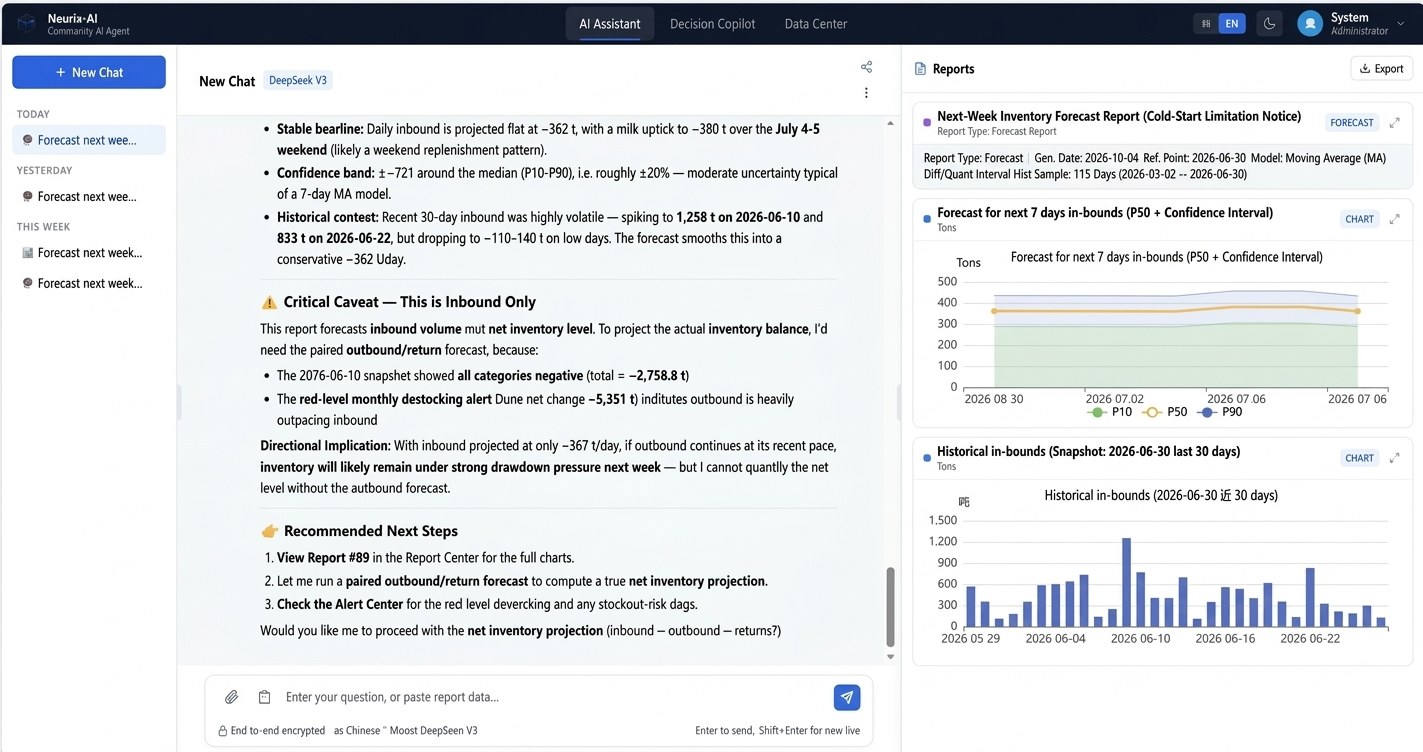
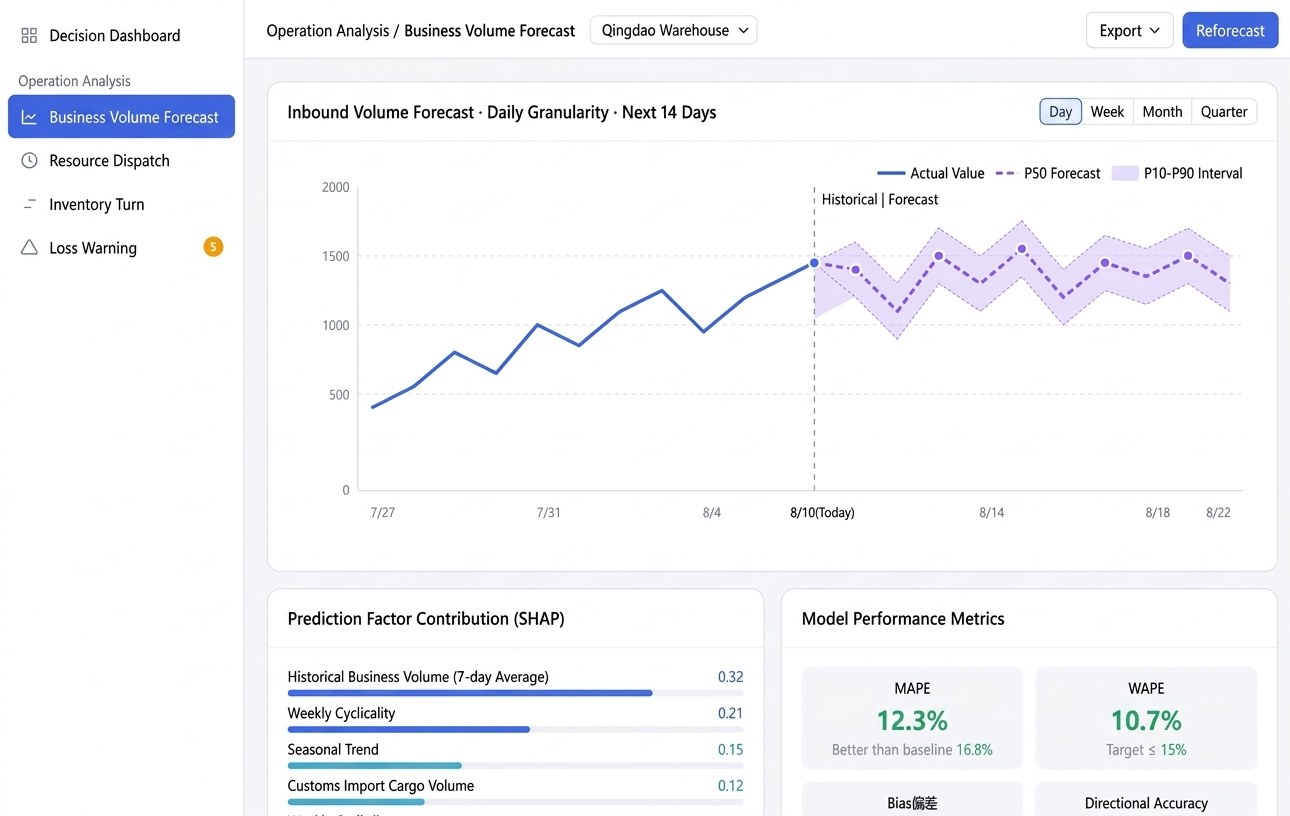
An AI analytics and agent platform for cold chain and commodity trading. It reads the whole stack, not one database — so forecasts, loss warnings and trading advice are grounded in operational reality rather than last month's export.
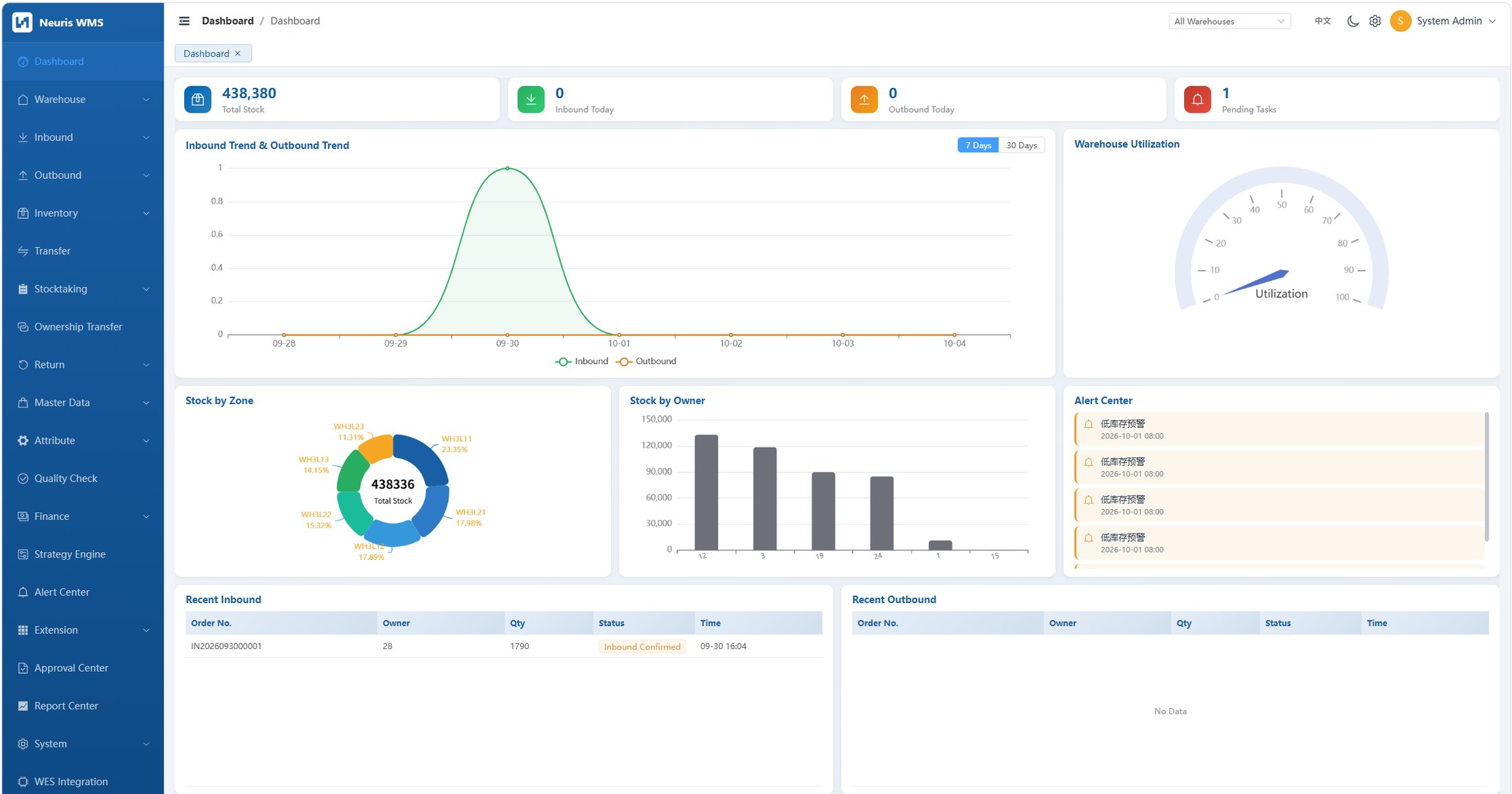
An enterprise warehouse management platform for cold chain logistics, bonded warehousing and 3PL. It owns the full business chain — inbound, outbound, inventory, stocktaking, transfer, ownership transfer, returns, customs declaration, financial billing and node control — across multiple owners and multiple account sets in one warehouse.
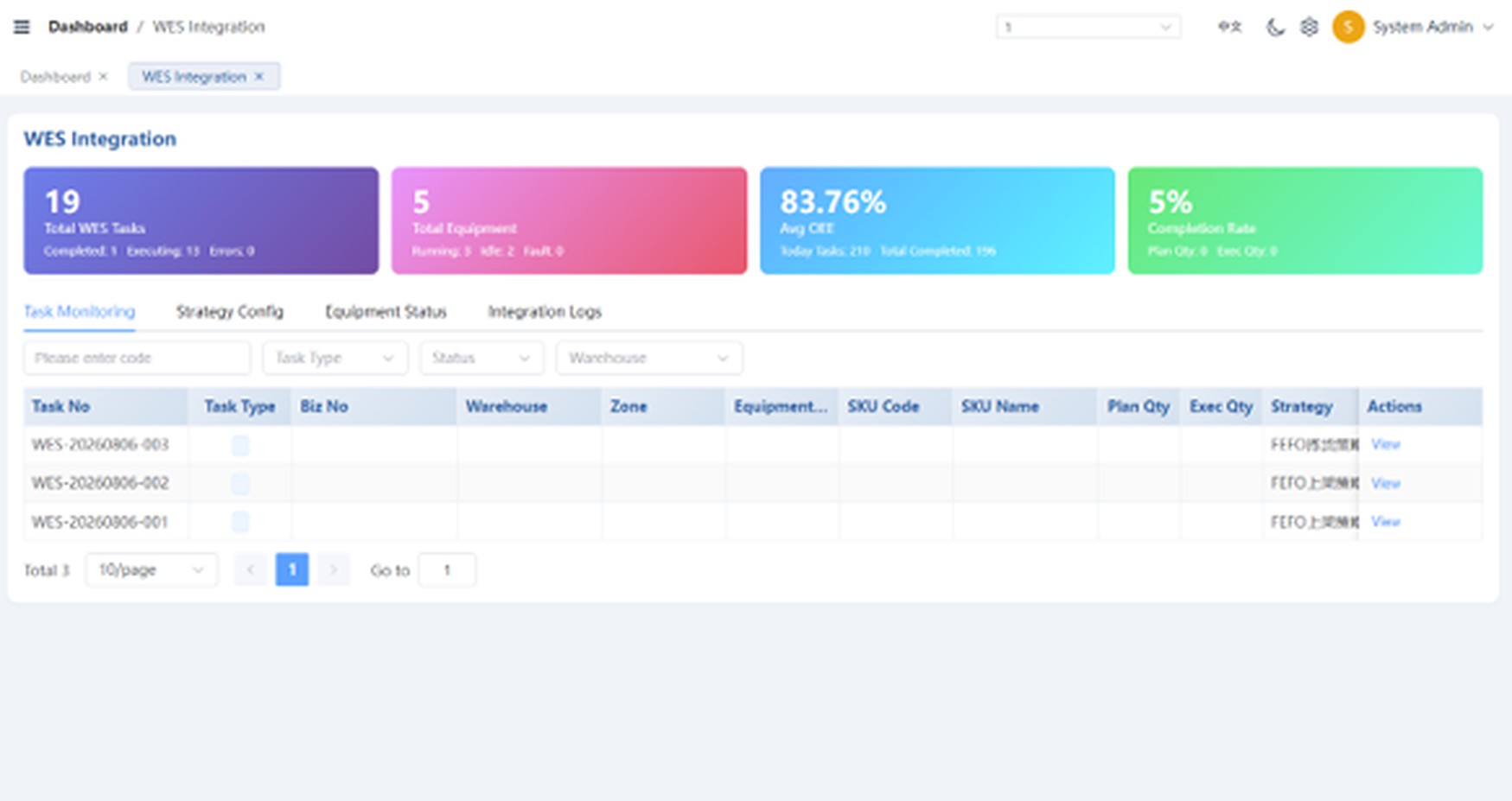
The automated cargo-orchestration hub between WMS and WCS. It receives business instructions upstream, generates inbound and outbound tasks, and converts them into device-level action downstream — closing the last-mile gap between business intent and machine movement.
The control hub of smart warehousing. It receives work orders from WMS, WES and ERP and breaks them into device-executable actions across stacker cranes, shuttles, 4-way shuttles, AGVs, robot arms, palletizers, wrappers and conveyors — replacing every device's standalone host software with one web platform.
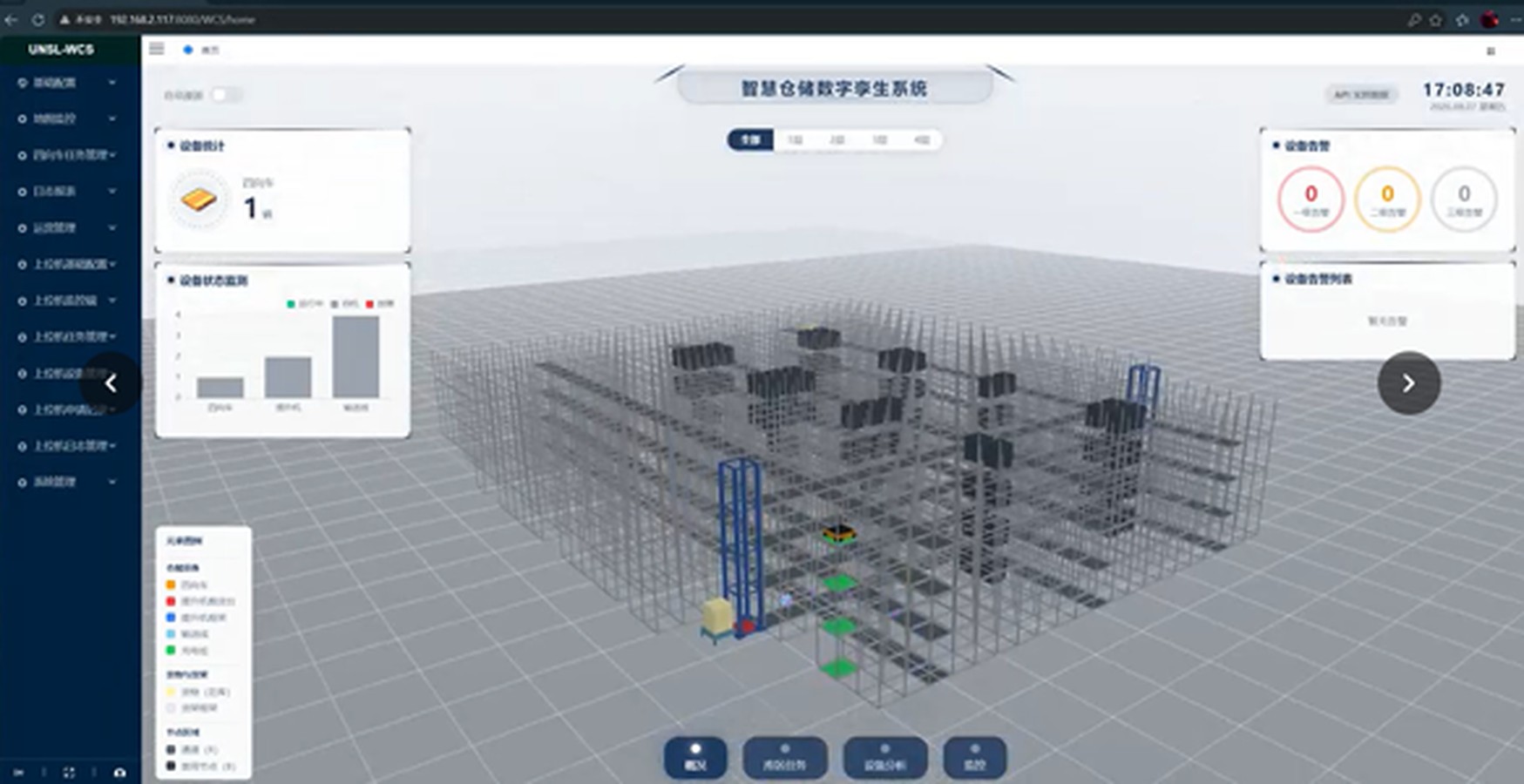
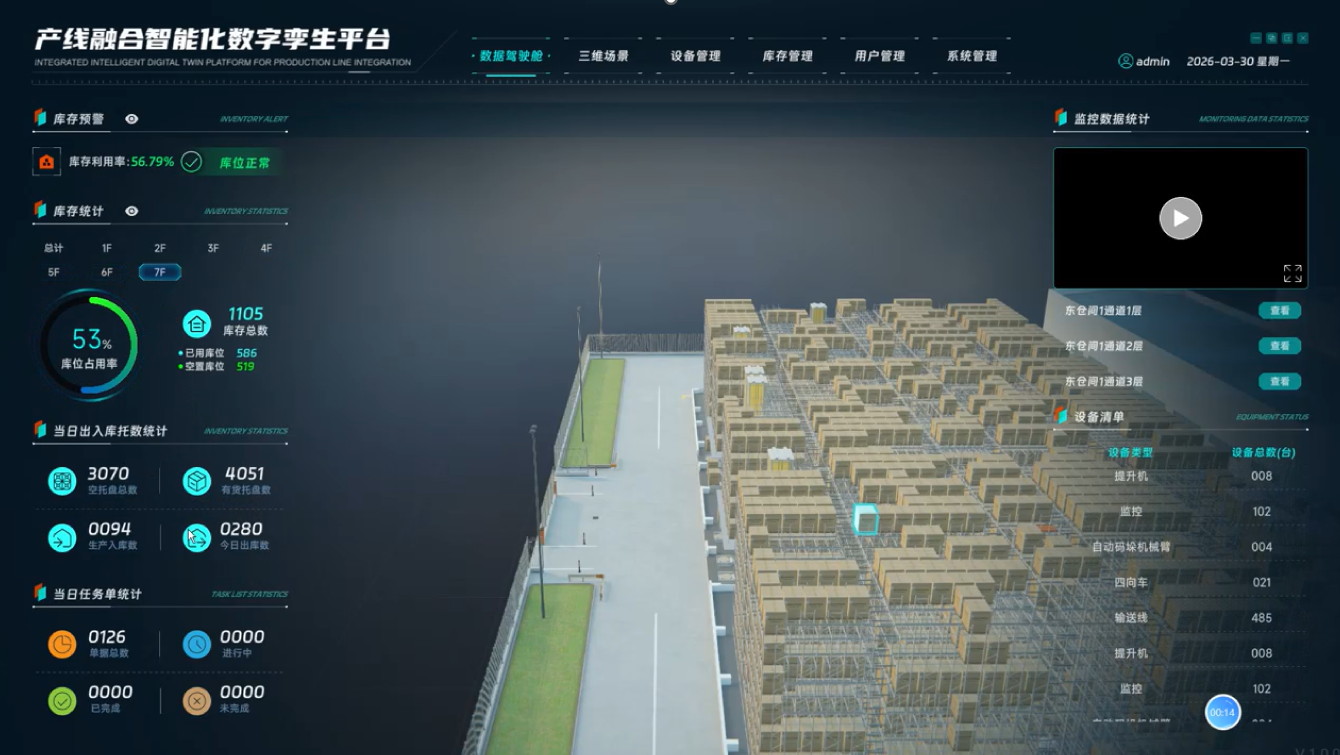
A live 3D replica of the physical warehouse, rendered from the same device telemetry the WCS dispatches on. Racking, stacker cranes, shuttles and AGVs are drawn where they actually are and move as they move — so an operator can see the building's state instead of inferring it from a table of device codes.
Neuris AI is an intelligence layer that reads the other four layers. It runs three engines — forecast and scheduling, inventory and loss control, and commodity price forecasting — and answers questions in plain language. It is an add-on, so it can sit on top of an existing WMS.
Neuris AI is the intelligence layer that sits across the WMS, WES, WCS and the 3D digital twin. It is an add-on, not a replacement — and it works on whatever you already run, because it ingests six different ways.
Predicts inbound and outbound volume, then builds shift plans from it — early, mid and night shifts, overtime levels, peak support. People when it is busy, nobody idle when it is quiet.
Turnover and ageing analysis with replenishment advice. Cold chain break monitoring scores every batch on fragility, break duration, age and remaining shelf life, then raises work-orders automatically. Loss becomes controllable, not discovered after the fact.
Interval and direction forecasting weighted across futures, spot, supply-demand index, customs unit price, FX and weather. Outputs a strategy card rather than a raw number.
NEURIS came out of cold chain and bonded warehousing — the two environments where off-the-shelf warehouse software fails hardest.
Multi-temperature zones from −25 °C frozen through chilled and transitional to ambient. FEFO expiry engine with batch traceability, three-level alerts and IoT break monitoring that produces work-orders instead of incidents.
Multiple owners co-warehousing under one roof, each with independent strategies, isolated data and owner-based billing. Internal, external, customs, park, finance and owner ledgers reconcile to one physical truth.
Eight declaration types linked directly to stock movement. Bonded accounts deduct automatically, so the customs position is never a month behind the physical one.
MES linkage for JIT material delivery to the line, automatic finished-goods putaway and line-side storage. High-bay storage for appliances, auto parts, chemicals, cold food and electronics.
High-throughput order fulfilment with cross-device task orchestration, sorter control and real-time capacity visibility. Peak handling without peak headcount.
Price-interval and direction forecasting across futures, spot, supply-demand, customs and FX. Evidence for procurement timing rather than intuition.
Both projects are in delivery. Customer names are withheld until commissioning consent is granted — reference contacts available on request.
NEURIS integrates upward to ERP, SAP, MES and TMS, and downward to PLCs. Upward it uses standard REST APIs with webhook status callbacks. Downward it speaks OPC UA, Modbus TCP, S7, MQTT and Socket. No existing system has to be replaced for it to work.
NEURIS connects upward to ERP, SAP, MES and TMS, and downward to mainstream PLCs. Nothing about your existing stack needs to be replaced for it to work.
SaaS subscription ready to use, or private deployment with data staying in-domain. Full implementation service from assessment to connection, configuration, pilot, training and optimisation.
Standard REST API to WMS, WES and ERP, plus webhook status callbacks. PLC layer via OPC UA, Modbus TCP, S7, MQTT and Socket — mainstream PLC brands supported.
Multi-language and multi-currency, so cross-border stakeholders read the same numbers.
JWT with refresh, RBAC down to module level, multi-tenant isolation, five-layer audit log, optimistic locking and rate limiting. PIPL-compliant handling.
Vue 3 Spring Boot 3.2 MySQL 8.0Java MySQL 8.0+ — Windows Server 2022+, CentOS 7.0+ or DockerVue.js 2.x Spring Boot 2.x MySQL 8 Redis — WebSocket push under 100 msThe four business blueprints behind NEURIS are detailed engineering documents, not marketing brochures — module inventories, protocol specifications, data models and measured outcomes, written by the team that built the platform.
Warehouse management blueprint — 25 backend modules, 34 document types, six differential ledgers, FEFO expiry across four temperature zones, eight customs declaration types and multi-owner settlement. 54 pages.
Request copy →Warehouse execution blueprint — 10 modules across four tabs, 30 task types, 19 device types, a five-level space hierarchy and a no-code strategy engine. Includes the RESTful API contract used to integrate upward to WMS/ERP and downward to WCS. 53 pages.
Request copy →Warehouse control blueprint — 9 functional modules, OPC UA / Modbus TCP / S7 / MQTT / Socket protocol bindings, task lifecycle and traceability model, alert levels and the dual-host hot standby topology. 47 pages.
Request copy →AI platform blueprint — the three product entrances (Assistant, Decision Copilot, Web Admin), the forecast, inventory-loss and commodity-price engines, six ingestion channels and the data quality pipeline. 33 pages.
Request copy →The questions we are asked most often in evaluation — what the platform is, how WMS, WES and WCS divide the work, and what it takes to adopt it.
NEURIS is an AI-powered unified software stack for automated warehousing, made up of five layers: Neuris WMS (warehouse management), Neuris WES (warehouse execution), Neuris WCS (warehouse control), Neuris 3D Digital Twin (live 3D visualisation of the physical warehouse) and Neuris AI (intelligence). It runs from ERP business instruction down to PLC device action in one flow, so there are no integration seams between layers.
A warehouse management system (WMS) decides what should happen — inventory, orders, expiry, customs and billing. A warehouse execution system (WES) turns that business instruction into coordinated task flow across automated equipment. A warehouse control system (WCS) turns tasks into device-level commands over protocols such as OPC UA, Modbus TCP, S7, MQTT and Socket. NEURIS supplies all three as one stack, so the handovers between them are internal rather than integrations you have to build and maintain.
Yes. NEURIS connects upward to ERP, SAP, MES and TMS through standard REST APIs with webhook status callbacks, and downward to mainstream PLCs via OPC UA, Modbus TCP, S7, MQTT and Socket. Existing systems do not need to be replaced.
Yes. Neuris WMS was built for cold chain first, with a FEFO (first-expired-first-out) expiry engine, four temperature zones spanning frozen at −25 °C through chilled and transitional to ambient, three-level alerts and batch traceability. Neuris AI adds IoT cold chain break monitoring that raises work-orders automatically when a batch is at risk.
Neuris WMS supports multiple owners co-warehousing under one roof with data isolation and independent strategies. Six differential ledgers — internal, external, customs, park, finance and owner — reconcile to one physical stock truth, and owner-based billing is generated from the same record.
Either as a SaaS subscription that is ready to use, or as a private deployment with data staying in-domain. Full implementation service is available from assessment through connection, configuration, pilot, training and optimisation. The interface is multi-language and multi-currency. High availability is provided by dual-host hot standby with failover under 10 seconds.
NEURIS was built in China and is in live operation across multiple automated warehouse deployments there, covering multi-temperature cold chain, bonded and customs-controlled facilities, and AS/RS and 4-way shuttle sites. EfficientX Asia holds the technology transfer for the platform and localises it for Asian markets — covering regulation and customs procedure, language and multi-currency, the equipment brands installed in the region, and local operating practices — with implementation and support delivered from Kuala Lumpur. The four published business blueprints total 187 pages of module inventories, protocol specifications and data models.
NEURIS WCS dispatches to 19 device types including stacker cranes, shuttles, 4-way shuttles, lifters, conveyors, AGVs, robot arms, palletizers, wrappers, sorters and chargers. One web platform replaces each device's standalone host software for dispatch, configuration, logging and monitoring.
The Neuris 3D Digital Twin is a live 3D replica of the physical warehouse, rendered from the same device telemetry the WCS dispatches on. Racking, stacker cranes, shuttles and AGVs are drawn where they actually are and move as they move, with device health overlaid on the model. It refreshes at 2 Hz and is used for monitoring, fault location, commissioning rehearsal and expansion planning.
It can, but it does not have to. Each layer is bought separately and priced separately, so a site can start with the WMS, with the WCS, or with Neuris AI added on top of an existing WMS. Because NEURIS ingests data six different ways — pasted reports, file import, direct database sync, API, IoT/MQTT and manual forms — the AI layer in particular works over whatever systems are already running.
A demo covers your actual configuration — temperature zones, equipment count, throughput target — not a generic product tour.
